A mining licence can be the legal foundation of a valuable African mineral project—or a convincing piece of paper attached to an asset the seller does not own, cannot transfer or has already allowed to lapse.
For investors, lenders and strategic partners, licence verification must come before geological excitement. High grades, promising drill results and images of operating equipment have little commercial value if the underlying mineral right is invalid, held by another company, outside its permitted area or burdened by unresolved obligations.
The central rule is simple: never verify a mining licence using documents supplied only by the seller. Confirm the right independently through the government authority that issued it, the official mining cadastre or register, the corporate registry and qualified local legal counsel.
This is particularly important because Africa is not a single mining jurisdiction. Each country has its own mining legislation, licence categories, renewal procedures, transfer restrictions, state interests, local-ownership rules and administrative systems. The African Mining Legislation Atlas allows users to compare legislation across countries, but it also warns that its information is not legal advice and recommends consulting qualified counsel.
Here is how to verify a mining licence in Africa before investing money, signing an acquisition agreement or accepting the licence as security.
1. Establish what kind of mineral right is being offered
The word “licence” is often used loosely. Before checking whether a document is authentic, determine what legal right it is supposed to create.
Depending on the jurisdiction, the asset may be described as:
A reconnaissance or prospecting right.
An exploration licence.
A retention licence.
A small-scale mining licence.
A large-scale mining licence or mining lease.
A quarrying or industrial-minerals permit.
A mineral-processing, buying, dealing or export licence.
A licence application that has not yet been granted.
These rights are not interchangeable. An exploration licence may permit geological work but prohibit commercial production. A gold-buying or processing permit does not necessarily grant the right to mine the land. An application gives the applicant no guaranteed ownership unless the law expressly provides an enforceable priority and all grant conditions are met.
Ask the seller to state, in writing, the exact licence category, legal rights granted, minerals covered and activities permitted. Compare that statement with the current mining law, regulations and licence conditions.
If the commercial proposal depends on immediate production but the asset holds only an exploration right, the project must be valued and structured as an exploration opportunity—not as an operating mine.
2. Identify the government authority with legal custody of the record
Licence verification should begin at the source. Identify the ministry, mining commission, cadastral office or regulator legally responsible for granting and maintaining mineral rights in the relevant country.
Some African jurisdictions provide online mining cadastre portals. For example, the Kenya Mining Cadastre Portal gives stakeholders an electronic channel for engaging with the Ministry of Mining, while Tanzania operates an online mining cadastre through its Mining Commission portal.
An online result is valuable, but it may not reveal every pending renewal, cancellation notice, appeal, transfer application, encumbrance or court order. Portal information should therefore be supplemented with a formal search, certified extract or written status confirmation from the responsible authority whenever possible.
The buyer's lawyer should confirm which document has legal authority if the online portal, physical register and seller's certificate contain different information.
3. Check the essential licence data point by point
The 2023 EITI Standard says public licence registers or cadastre systems should contain timely information including the licence holder, coordinates, application and award dates, duration and—in the case of production licences—the commodity being produced. These fields provide a strong minimum framework for an investor's verification process.
Confirm each of the following directly against the official record:
Licence number
The number on the certificate must match the number in the official register and in all renewal, payment and compliance records. Watch for altered digits, recycled templates or confusion between an application reference and a granted licence number.
Registered holder
Record the holder's exact legal name, company number and jurisdiction of incorporation. Small differences in spelling can identify a different company. A licence issued to an individual, subsidiary or joint venture is not automatically owned by the person or parent company marketing the transaction.
Licence category
Confirm whether the right is for exploration, mining, processing, trading or another regulated activity. Identify all limits on depth, production scale, mining method and permitted activity.
Minerals covered
A licence over land containing gold does not necessarily grant the right to mine gold. Check the mineral or mineral group named in the official record and whether associated minerals require a separate approval.
Official coordinates and area
Obtain the complete coordinate schedule, map projection, datum, cadastral units and licensed area from the regulator. A map image without machine-readable coordinates is insufficient for a serious investment.
Application and grant dates
Confirm when the application was lodged, when the right was granted and whether any competing or earlier applications affect priority.
Effective date and expiry
Determine when the licence became effective, its original term and its current expiry date. Do not assume an application for renewal keeps the right valid. Ask counsel to confirm the legal effect of a pending renewal in that jurisdiction.
Current status
The register should identify whether the licence is active, pending renewal, suspended, surrendered, expired, cancelled or under appeal. Obtain details of any notice of breach or proposed cancellation that has not yet appeared on a public portal.
Licence conditions
Review the original grant letter, licence schedule, approved work programme and every special condition. Conditions may relate to minimum expenditure, local procurement, employment, reporting, community obligations, environmental approvals or commencement deadlines.
Payments and statutory filings
Check annual fees, surface rents, royalties, taxes, renewal fees and penalties. Obtain official receipts and, where possible, a regulator statement showing that the account is current.
Encumbrances and third-party interests
Establish whether the licence has been pledged, mortgaged, charged, optioned or made subject to a royalty, stream, farm-in, joint venture or court order. Search both the mining register and the relevant corporate or security-interest registry.
Transferability
Confirm whether the licence can legally be assigned and whether a direct or indirect change of control requires ministerial, regulatory, competition, investment or exchange-control approval.
Every discrepancy should be logged, investigated and resolved before money moves.
4. Plot the official coordinates independently
Coordinates are where document verification meets the physical asset. An authentic licence can still be commercially useless if the deposit, shafts, pits, processing plant, water source or access road lies outside its legal boundary.
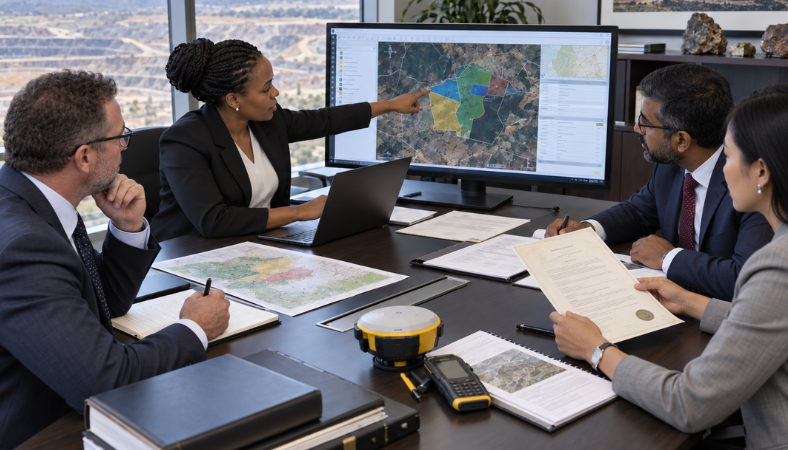
Give the official coordinate schedule to an independent surveyor or geographic information system specialist. The specialist should:
Confirm the correct coordinate reference system and datum.
Plot the licence polygon using official coordinates rather than tracing a seller's map.
Calculate the licensed area and compare it with the official record.
Check for self-intersections, missing points and obvious transcription errors.
Overlay drill collars, trenches, artisanal workings, pits and proposed infrastructure.
Identify overlaps with neighbouring licences, pending applications, protected areas and restricted zones.
Compare the plotted boundary with physical survey markers where these exist.
Record the date and source of every spatial dataset used.
Do not accept explanations such as “the mineralisation continues into that area” unless the seller legally controls that area. Mineral potential outside the licence boundary should contribute no acquisition value.
If the cadastre reveals an overlap, obtain a written legal opinion explaining priority and the competent authority's formal position. A seller's assurance that an overlap is an administrative error is not enough.
5. Match the licence holder to the corporate registry
Once the official record identifies the holder, confirm that entity independently at the national companies registry.
Obtain current and historical records covering:
Incorporation and registration status.
Registered office and principal place of business.
Directors, company secretary and authorised representatives.
Shareholders and changes in ownership.
Ultimate beneficial owners.
Annual returns and good standing.
Insolvency, liquidation or deregistration proceedings.
Registered charges, security interests and creditors.
Restrictions contained in the company's constitutional documents or shareholder agreements.
The EITI beneficial ownership framework emphasises the importance of identifying the real people who own or control extractive companies. Complex chains of shell companies can conceal conflicts of interest, politically exposed persons, sanctions exposure or a party that has no authority to sell.
Ask the licence holder—not only the broker—to confirm the proposed transaction. Verify board and shareholder resolutions, powers of attorney and signatory authority. If the seller is disposing of shares in a holding company, trace ownership down to the licensed entity and check whether the mining law treats the deal as an indirect licence transfer.
6. Reconstruct the full history of the licence
A current certificate shows only part of the story. Reconstruct the right from application to the proposed transaction.
Request:
The original application and supporting documents.
Evidence of technical and financial capacity submitted at application.
The grant notice, licence certificate and coordinate schedule.
Every renewal, amendment, conversion, reduction and surrender document.
Annual work programmes and expenditure reports.
Geological reports and statutory data submissions.
Fee, rent, royalty and tax receipts.
Inspection reports and regulator correspondence.
Warnings, breach notices, suspension notices and responses.
Transfer applications and approvals.
Court cases, administrative appeals and competing claims.
Agreements with previous owners, local partners and joint-venture participants.
Build a chronological record and investigate gaps. A licence that appears active today may be vulnerable because the holder failed to meet historic expenditure, reporting or renewal obligations.
The investor's counsel should distinguish between an administrative defect that can be corrected and a fundamental failure that threatens the right itself.
7. Verify compliance—not merely the expiry date
A licence can remain visible as “active” while the holder is in breach of its conditions. Check whether the company has complied with every obligation necessary to keep the right in good standing.
These may include:
Minimum annual exploration expenditure.
Approved work programmes and commencement deadlines.
Periodic geological and operational reports.
Relinquishment or area-reduction requirements.
Environmental monitoring and rehabilitation.
Local employment, procurement and training commitments.
Community development agreements.
Health, safety and production reporting.
Royalty, rental, licence-fee and tax payments.
Notice and approval requirements for ownership changes.
Request confirmation from the relevant departments rather than relying on one generic letter. The cadastre office may confirm title, while environmental, tax, land, water or local-government agencies hold separate compliance records.
Quantify the cost and time required to cure every breach. Where a licence is exposed to cancellation, renewal refusal or penalties, the buyer should make correction and written regulatory clearance conditions precedent to closing.
8. Confirm that the proposed transaction is legally permitted
An investor may verify that a licence is valid and still lose money by using the wrong acquisition structure.
The applicable law may regulate:
Direct assignment of the mineral right.
Sale of shares in the licence holder.
Indirect change of control through an offshore parent company.
Farm-in, option, tribute or joint-venture agreements.
Creation of security over the licence.
State participation or free-carried interests.
Local ownership and local-content requirements.
Foreign investment, competition and exchange control.
Transfers between related parties.
Ask local counsel to provide a written approvals matrix naming each authority, document, fee, expected sequence and legal condition. The answer must be based on current law and the specific transaction—not a previous deal or informal statement.
The EITI licence-allocation requirements call for transparency around licence awards and transfers, including the applicable process, recipient, technical and financial criteria and material deviations. Investors should use available national EITI disclosures as an additional cross-check, while recognising that the regulator's current record and local law remain decisive.
Do not pay the full purchase price on signing if approvals are still outstanding. Use conditions precedent, escrow, staged consideration and clear termination or refund rights.
9. Check whether the licence carries the rights the project needs
Mineral title is only one part of lawful operations. A mining licence may not automatically provide surface access, water, environmental approval, construction permission, electricity rights or authority to export minerals.
Verify the project's connected rights and permits, including where applicable:
Surface ownership, leases and access agreements.
Customary land and community rights.
Environmental and social impact assessment approval.
Environmental management and rehabilitation plans.
Water abstraction, storage and discharge permits.
Tailings and waste-disposal approvals.
Explosives, fuel and hazardous-chemical permits.
Construction and land-use approvals.
Processing, refining, trading and export licences.
Forestry, biodiversity and protected-area consents.
Power, road and infrastructure easements.
Heritage and archaeological clearances.
Confirm that these approvals are issued to the correct entity, cover the intended area and activity, remain valid and can survive or be transferred through the proposed transaction.
A mining licence without lawful land access or environmental approval may be valid but commercially stranded.
10. Investigate disputes, overlaps and community claims
Search beyond the cadastre. Review court databases, official gazettes, regulator decisions, parliamentary records and credible media for disputes involving the licence, licence holder, beneficial owners and project area.
Investigate:
Competing title applications or overlapping licences.
Boundary disputes with neighbouring licence holders.
Claims by former shareholders, joint-venture partners or financiers.
Challenges to the original award or renewal.
Judicial review and administrative appeals.
Community complaints, customary-land claims and compensation disputes.
Artisanal or small-scale miners working inside the area.
Illegal mining, security incidents and human-rights allegations.
Environmental enforcement and rehabilitation orders.
Unpaid contractors asserting liens or retention rights over equipment.
Visit the site with appropriate local and technical advisers. Speak to legitimate local authorities, landholders and community representatives through a controlled process. The purpose is to compare the legal record with actual occupation and use—not to make promises before the buyer understands its obligations.
11. Authenticate every material document
Document fraud does not always involve a completely invented licence. More sophisticated cases may use a genuine certificate with altered coordinates, dates, holder details or mineral rights.
Apply a controlled authentication procedure:
Obtain certified or digitally verifiable records from the issuing authority.
Compare document numbers, seals, signatures, QR codes and payment references with official records.
Contact the authority using independently sourced details—not telephone numbers or email addresses printed only on seller documents.
Confirm that the official who signed the document held the relevant authority on the signing date.
Check whether amendments follow the legally required process.
Preserve copies, search receipts, correspondence and verification dates in the transaction file.
Require translations by an independent qualified translator where records are not in the buyer's working language.
Email confirmation from an individual official should be supported by a formal search, certified record or official letter wherever possible. The verification record must be strong enough for the buyer's investment committee, lender, insurer and future acquirer to audit.
12. Build a licence-verification data room
Before paying for technical due diligence, require the seller to populate a controlled title and compliance folder.
The minimum file should contain:
Official title records
Current certificate, grant letter, cadastral extract, official map and coordinate schedule.
Application and renewal history
Original application, renewals, conversions, amendments, relinquishments and official decisions.
Compliance evidence
Work programmes, expenditure reports, statutory reports, inspection results and all regulator correspondence.
Payment evidence
Official receipts for application fees, annual charges, surface rent, royalties, penalties and relevant taxes.
Corporate ownership
Incorporation records, director and shareholder registers, beneficial ownership, group structure and authority resolutions.
Transaction rights
Transfer provisions, existing options, joint ventures, royalties, streams, security interests and third-party consents.
Connected permits
Land, environmental, water, construction, processing, explosives and export approvals.
Disputes
Litigation, appeals, objections, notices, community grievances and settlement agreements.
Maintain a verification log showing who checked each document, the official source, date, result and outstanding issue. Seller-supplied documents should remain marked “unverified” until independently confirmed.
13. Match the depth of verification to the capital at risk
Every investor must verify legal title, but the scale of professional work should increase with the transaction's complexity and exposure.
Small investors and early-stage opportunities
At minimum, obtain an official cadastral search, corporate search, coordinate review and written advice from licensed local mining counsel before paying a deposit. Use conditional, staged funding tied to verified milestones.
Do not reduce title diligence because the initial cheque is small. Fraudulent opportunities often target smaller investors precisely because professional verification appears expensive relative to the first payment.
Medium-sized acquisitions and joint ventures
Add a detailed title opinion, independent survey, historic compliance audit, beneficial-ownership review, litigation searches, site inspection and full approval matrix. Build escrow, warranties, indemnities and milestone funding into the transaction.
Large mines and institutional transactions
Commission multidisciplinary legal, cadastral, tax, sanctions, anti-bribery, land, environmental and social diligence. Verify every subsidiary and material permit, obtain direct regulator engagement, assess political-risk protection and align closing with lender requirements.
The larger the transaction, the less acceptable it is to rely on undocumented assurances.
14. Recognise the licence red flags
Stop or pause the investment process if:
The seller provides only a photograph, screenshot or laminated copy of the licence.
The licence number cannot be found in the official system.
The portal names a different holder, commodity or licence category.
The seller prevents contact with the regulator or insists on using only its own contact person.
Coordinates are missing, incomplete or supplied in an unknown reference system.
The mine workings or deposit lie outside the plotted boundary.
The licence has expired and the seller relies only on a renewal application.
Annual fees, rents or work commitments are unpaid.
Corporate records do not match the stated licence owner.
A broker claims authority but the registered holder will not confirm it.
Several parties claim mandates over the same licence.
The transaction requires approval, but the seller promises that approval is “automatic.”
The seller requests payment to an unrelated person, agent or foreign account.
Community members, artisanal miners or former partners claim rights that are absent from the data room.
There are unexplained gaps in the licence history.
The seller demands urgency before official verification can be completed.
One inconsistency may be curable. Several connected inconsistencies can indicate defective title, misrepresentation or fraud.
15. A practical ten-day licence verification sprint
A preliminary title review can often identify fatal flaws quickly, although complex cases will require more time.
Days 1–2: identify the right and the parties
Obtain the licence number, official holder, company registration details, coordinates, seller mandate and proposed transaction structure. Identify the issuing authority and engage local mining counsel.
Days 3–4: search government and corporate records
Run cadastral, company, beneficial-ownership, security-interest and litigation searches. Request a certified extract or formal regulator confirmation.
Days 5–6: test the spatial evidence
Plot the official coordinates, compare the area with the seller's maps and overlay drill holes, mineralisation, workings and infrastructure. Check competing and neighbouring rights.
Days 7–8: audit maintenance and compliance
Review the complete licence history, fees, rents, work programmes, reporting, breach notices, renewals and connected land or environmental approvals.
Days 9–10: determine transferability and decide
Obtain the legal approvals matrix and preliminary title opinion. Classify each issue as cleared, curable, priceable or fatal. Decide whether to reject the opportunity, continue full due diligence or issue a conditional offer.
No timetable should force an investment where official confirmation remains outstanding.
What licence verification can—and cannot—prove
Successful licence verification establishes that the relevant authority recognises a particular holder's legal right over a defined area, subject to stated conditions and the limits of the investigation.
It does not prove that:
An economic mineral deposit exists.
Seller-provided grades or resource estimates are reliable.
The project is technically mineable.
Metallurgical recovery will be profitable.
Infrastructure and finance are available.
Environmental and community risks are acceptable.
The licence can be transferred without further approval.
Title verification is therefore a gateway to full due diligence—not a substitute for it.
The investment rule: verify first, value second, pay last
The safest sequence is straightforward. Confirm the seller's authority. Verify the mining licence with the state. Plot the legal boundary. Test compliance and connected permits. Establish the approval route. Only then should the investor assign value, negotiate binding terms or release capital.
For legitimate licence holders, this discipline is an advantage. A clean corporate structure, verified cadastral record, complete compliance history and organised data room can shorten the transaction process and distinguish a credible African mining opportunity from the noise.
For investors, the cost of verification is small compared with the price of acquiring a right that does not exist, cannot be transferred or is already at risk of cancellation.
AFRINOMICS connects serious investors, operators and advisers with controlled African mining opportunities through structured transaction pathways.
Looking for a verified mining acquisition, joint venture or investment opportunity? Enter the AFRINOMICS Deal Room to review controlled mandates and live deal-room teasers.
Editorial note: This article provides general information and does not constitute legal, technical, tax or investment advice. Mining laws, licence systems and transfer requirements differ by country and may change. Investors should obtain current written advice from qualified counsel and independent specialists in the relevant jurisdiction.
Authoritative reference points
African Mining Legislation Atlas
EITI Requirements: Legal framework, licence allocations and registers
EITI Beneficial Ownership
Kenya Mining Cadastre Portal
Tanzania Mining Commission Cadastre Portal