Buying a gold mine in Africa can provide access to one of the continent's most established mineral industries. It can also expose a buyer to disputed licences, overstated resources, untested metallurgy, unpaid taxes, community conflict and rehabilitation costs large enough to destroy the investment case.
The decisive issue is therefore not whether gold occurs on the property. It is whether the buyer can obtain an enforceable interest in a legally compliant project whose gold can be mined, processed and sold profitably.
That conclusion must be earned through independent due diligence. Seller presentations, assay certificates, production photographs and estimates of “gold in the ground” are starting points—not proof of title, value or bankability.
Africa is not one mining jurisdiction. Licence types, transfer rules, state participation, local ownership requirements, taxes, royalties, foreign-exchange controls and environmental obligations vary by country and can change. The African Mining Legislation Atlas helps investors compare legal frameworks, but it expressly recommends obtaining qualified legal advice. Current legislation, official registries and written confirmation from the relevant authorities must govern every transaction.
This AFRINOMICS guide sets out the commercial, legal, technical, environmental and integrity checks a disciplined buyer should complete before acquiring an exploration property, development project or operating gold mine.
1. Define exactly what is being acquired
“Buying a gold mine” can describe several very different transactions. The structure determines what the buyer controls, which approvals are required and which liabilities may follow the asset.
A buyer may acquire:
Shares in the company that owns the project. This may preserve existing licences and contracts, subject to change-of-control rules, but can also transfer historic corporate, tax, employment, environmental and litigation liabilities.
The mining licence and selected project assets. This may allow the buyer to leave some company liabilities behind, but the licence transfer, land rights, permits and contracts may each require separate consent or replacement.
An earn-in or farm-in interest. The buyer earns ownership by funding exploration, studies or development milestones. This can reduce initial exposure, but the agreement must define budgets, operatorship, dilution, default, data ownership and the route to a mine-development decision.
A joint-venture interest. This provides local or technical partnership, but governance, reserved matters, funding calls, deadlock and exit rights become central.
A producing operation, including plant, mobile equipment, infrastructure, inventory and workforce. Here the buyer must test operational performance and working capital as carefully as the orebody.
The acquisition perimeter should be written down before detailed diligence begins. List every company, licence, permit, parcel of land, building, plant item, vehicle, contract, dataset and intellectual-property right that is included—and everything that is excluded.
2. Verify the seller, its owners and its authority to transact
The first risk is often not geological. It is whether the party marketing the mine actually owns or controls it and has authority to sell.
Obtain current, independently verified corporate records for the licence holder and every relevant parent, subsidiary and joint-venture entity. Confirm:
Legal name, registration number, registered office and good standing.
Directors, shareholders and ultimate beneficial owners.
Articles, shareholder agreements and restrictions on transferring shares or assets.
Board and shareholder approvals required for the transaction.
Existing options, royalties, streaming arrangements, earn-ins, pledges, liens or security interests.
Litigation, insolvency proceedings, creditor claims and unpaid judgments.
The authority of every broker, adviser or mandate holder involved.
Do not rely on a mandate letter alone. Ask the licence-holding company to confirm the representative's authority directly. Where several intermediaries claim the same asset, stop the process until the seller establishes a single verified chain of authority.
Run know-your-counterparty checks on the seller, beneficial owners, directors and material agents. These should cover sanctions, politically exposed persons, anti-money-laundering risk, adverse media, bribery allegations and conflicts of interest. Establish the source of funds for the transaction and document all commissions and success fees.
3. Confirm the mining title directly with government
A scanned licence is not title verification. The buyer's local mining counsel should check the official mining cadastre, ministry, regulator and, where relevant, land registry. Seek written confirmation wherever the system permits.
Verify:
Licence number, holder, type and mineral covered.
Official coordinates, area and cadastral status.
Grant date, expiry date and remaining term.
Renewal history and conditions for renewal.
Annual fees, surface rents, taxes and royalties paid or outstanding.
Minimum expenditure, work programmes and reporting obligations.
Environmental, community, local-content and rehabilitation commitments.
Whether the title is suspended, under cancellation, challenged, mortgaged or subject to competing applications.
Whether an asset transfer, share sale or indirect change of control needs ministerial, regulatory, competition or foreign-investment approval.
Mandatory state participation, free-carried interests, local equity, beneficiation or domestic-sale requirements.
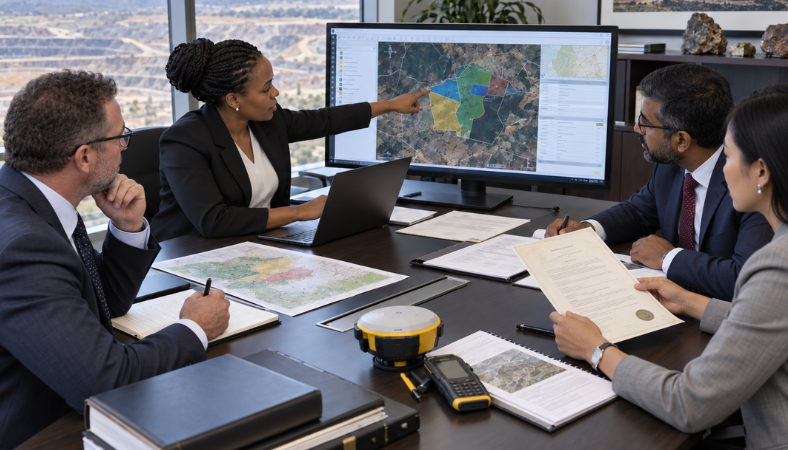
Plot the official coordinates independently. Reconcile them with the seller's maps, drill collars, pits, plant, tailings facilities and access routes. A valuable orebody located outside the valid licence boundary is not an acquisition asset.
The sale agreement should make all material governmental consents conditions precedent to closing. The buyer should not release the full purchase price while the licence transfer or change of control remains uncertain.
4. Separate mineral title from land and access rights
A mining or exploration licence does not necessarily give unrestricted rights over the surface. Determine who owns, occupies or uses the land and what rights are required for exploration, mining, roads, power lines, water infrastructure, camps, waste dumps and tailings storage.
Review title deeds, leases, customary rights, access agreements, compensation records, resettlement commitments and unresolved grievances. Map farms, settlements, sacred sites, protected areas, forests, watercourses and artisanal workings against the proposed mine footprint.
Meet legitimate community representatives and local authorities through an appropriately managed process. The purpose is not to bypass the seller or make premature promises. It is to test whether documented agreements reflect conditions on the ground and whether the project has a credible social licence to operate.
Where Indigenous Peoples, physical displacement or economic displacement may be affected, determine the applicable national requirements and international lender standards. The IFC Performance Standards are a useful financing benchmark for environmental and social risk management, land acquisition, biodiversity, cultural heritage and Indigenous Peoples, but compliance with them does not replace national law.
5. Establish what the geology actually supports
The commercial value of a gold project depends on the quality of its evidence. The buyer's independent geologist should start with the original data, not the seller's summary slides.
Collect and review:
Geological maps, interpretations and deposit model.
Drill-hole collar files, downhole surveys, logs and core photographs.
Original laboratory certificates and digital assay files.
Sampling protocols, sample preparation and chain-of-custody records.
Quality assurance and quality control results, including standards, blanks and duplicates.
Bulk-density measurements and methods.
Topographic and coordinate reference systems.
Three-dimensional wireframes, block models and estimation parameters.
Cut-off grades, capping, compositing, variography and classification assumptions.
Historic mining, artisanal depletion and production reconciliation.
Technical reports and the credentials, independence and consent of the responsible professionals.
The buyer must distinguish four terms that are often blurred in weak promotions.
An exploration result is geological or assay information. It is not an inventory of mineable gold.
An exploration target expresses conceptual potential, usually as a range, where evidence is still insufficient to estimate a mineral resource.
A mineral resource is a concentration with reasonable prospects for eventual economic extraction, classified according to confidence under the applicable reporting code.
A mineral reserve is the economically mineable part of a measured or indicated resource after relevant modifying factors and an appropriate study have been applied.
Do not assign reserve-level value to grab samples, artisanal production, geophysical anomalies or an unclassified estimate. Under the SAMREC framework, reporting of Exploration Results, Mineral Resources and Mineral Reserves is built around materiality, transparency and competence, and the underlying documentation must be prepared by or under the direction of a Competent Person. The official SAMCODES resource centre also provides the SAMREC and SAMVAL codes and guidance.
The applicable reporting standard may instead be another CRIRSCO-aligned code or a jurisdiction-specific securities rule. Whatever the standard, the buyer should instruct an independent qualified professional to state what can—and cannot—be relied upon.
6. Reproduce critical technical evidence
Data-room review is not enough for a material acquisition. Independent specialists should visit the site and test the information against physical evidence.
Depending on project stage and risk, the programme may include:
Checking licence and drill-collar coordinates with independent survey equipment.
Inspecting drill core, sample storage, trenches, adits and pits.
Re-logging selected core and verifying geological contacts.
Taking duplicate, umpire or check samples under controlled chain of custody.
Sending samples to an appropriately accredited laboratory selected by the buyer.
Drilling confirmation or twin holes where historic data is unreliable or the acquisition value depends heavily on a small number of intersections.
Reconciling recent ore feed, grades, recoveries and bullion production at an operating mine.
The aim is not to repeat every metre of drilling. It is to test whether the dataset is authentic, spatially correct, representative and capable of supporting the claimed interpretation.
7. Prove that the gold can be recovered economically
Grade alone does not determine value. Mineralogy and metallurgy decide how much gold can be recovered, how consistently it can be recovered and at what cost.
Review whether test samples represent the deposit's major ore types, grade ranges, weathering profiles and spatial variability. Examine:
Head-grade verification and mineralogical characterisation.
Gravity-recoverable gold.
Cyanide leach kinetics and reagent consumption.
Comminution, grind size and power requirements.
Flotation or pre-concentration options where relevant.
Refractory gold, preg-robbing carbon, sulphides and deleterious elements.
Recovery variability by domain, depth and ore type.
Water quality, water balance and seasonal availability.
Tailings characteristics and detoxification requirements.
Expected doré quality, refining terms and payable metal.
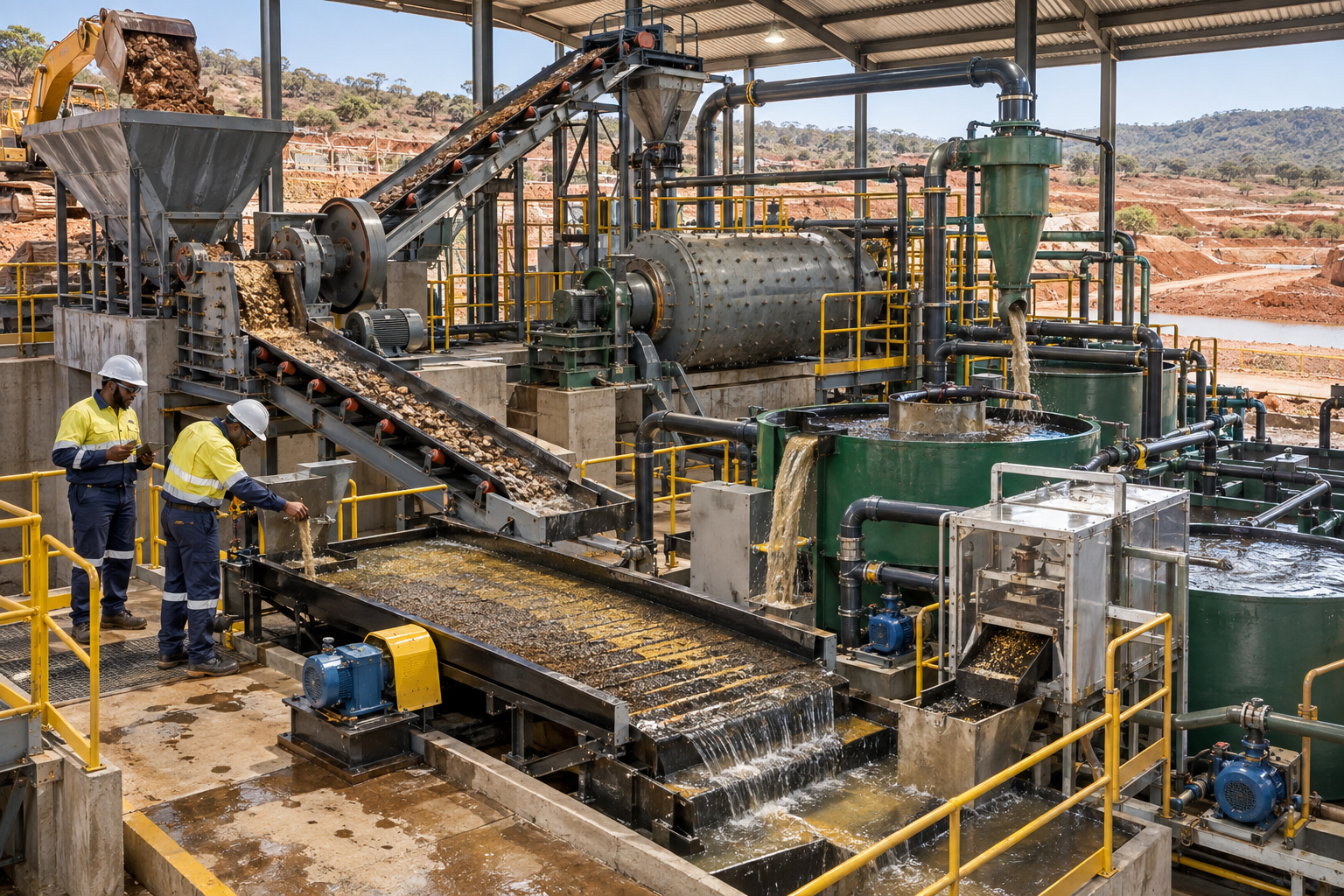
For an existing plant, compare design criteria with actual throughput, availability, recovery, reagent use, maintenance history and bottlenecks. Historic recovery cannot simply be applied to a new ore source. For a development project, use independent, representative testwork to design the flowsheet and estimate capital and operating costs.
8. Test the mine plan, infrastructure and operating assumptions
A resource model becomes an investment only when it can support a practical mining and processing plan.
Independent mining engineers should review:
Open-pit or underground design and scheduling.
Geotechnical assumptions, slope angles and ground support.
Hydrogeology, dewatering and flood risk.
Ore loss, dilution and mining recovery.
Strip ratio, development metres and production ramp-up.
Equipment selection, productivity and contractor assumptions.
Grade control, stockpiling and reconciliation systems.
Waste-rock placement and tailings capacity.
Power supply, fuel, roads, bridges, rail, port and air access.
Water abstraction rights and competing users.
Security, workforce availability, accommodation and emergency response.
Inspect material infrastructure rather than accepting replacement values supplied by the seller. Determine ownership, remaining useful life, maintenance backlog, spares availability and whether imported equipment can be supported locally.
For an operating mine, analyse monthly production—not only annual averages. Reconcile mined tonnes and grade to plant feed, recovery, doré production, refinery statements, sales receipts and royalties. Unexplained metal-accounting gaps require resolution before valuation.
9. Quantify environmental, social and closure liabilities
Environmental liabilities can remain long after the gold has been sold. A buyer should commission independent legal, environmental, social, water, geotechnical and tailings reviews proportionate to the asset.
Verify all environmental and operating permits, environmental and social impact assessments, management plans, monitoring data, regulator correspondence, incidents, fines and community complaints. Establish whether each approval matches the current or proposed mine plan.
Inspect:
Tailings storage facilities, embankments, seepage and emergency preparedness.
Waste-rock dumps and potential acid rock drainage or metal leaching.
Water abstraction, discharge, contamination and downstream users.
Cyanide storage, transport, use and detoxification.
Mercury use or historic mercury contamination, particularly around former artisanal processing.
Fuel, chemicals, contaminated soils and hazardous waste.
Biodiversity, forests, protected areas and rehabilitation performance.
Worker health and safety, contractor controls and accident history.
Community agreements, grievances, resettlement and livelihood restoration.
Illegal or informal mining and the security response to it.
Closure design, cost estimate, financial provision and post-closure monitoring.
Tailings diligence should be tested against recognised good practice such as the Global Industry Standard on Tailings Management, which covers the full facility lifecycle. Gold operations using cyanide should also consider the principles and assurance framework of the International Cyanide Management Code.
Recalculate closure costs independently using current quantities, contractor rates and regulatory requirements. Check whether the rehabilitation bond, trust or guarantee is sufficient, transferable and accessible to the regulator. A nominal accounting provision is not proof that closure is funded.
The purchase agreement must state who bears pre-closing contamination, rehabilitation, community and safety claims. Where uncertainty is material, use a price reduction, escrow, holdback, specific indemnity or require remediation before closing.
10. Build the economics from verified assumptions
Do not value an African gold mine by multiplying estimated ounces by the spot gold price. Most of that gross metal value will never become free cash flow.
The financial model should connect the verified resource or reserve model to the mine schedule, processing recovery, saleable gold, operating costs, capital expenditure, taxes and closure. It should include:
Initial, deferred and sustaining capital.
Mining, processing, site administration and transport costs.
Royalties, state participation and production-linked payments.
Corporate income tax, withholding tax, VAT treatment, customs and duties.
Refining, insurance and security costs.
Working capital and inventory build.
Rehabilitation and closure funding.
Financing costs and transaction fees.
Foreign-exchange assumptions, convertibility and repatriation constraints.
Inflation and escalation by currency.
Contingency appropriate to the study stage.
Test net present value, internal rate of return, payback and liquidity under downside cases—not only the seller's base case. Stress lower grade, reduced recovery, higher strip ratio, delayed ramp-up, power interruption, capital overrun, higher tax or royalty, currency movement and lower gold price. Run combined scenarios because mining risks rarely arrive one at a time.
Use an independent mineral-asset valuation professional and a recognised valuation framework appropriate to the transaction and jurisdiction. Where applicable, the SAMVAL Code provides principles and minimum standards for public reporting of mineral-asset valuations through SAMCODES.
11. Verify tax, finance, contracts and route to market
Review audited financial statements, management accounts, bank records, tax filings, payroll, creditors, debt, related-party transactions and capital expenditure. Trace gold sales from refinery statements and invoices to bank receipts.
Material contracts may include:
Refining and doré transport.
Offtake, streaming, royalty and hedging arrangements.
Mining, drilling and laboratory services.
Power, fuel and water supply.
Equipment leases and maintenance.
Land access, community development and compensation.
Employment, collective bargaining and key management.
Insurance and security.
Debt facilities and security documents.
Determine whether each contract can be assigned, whether a change of control creates termination rights and whether pricing is on market terms. Identify undisclosed related parties and commitments that could divert future revenue.
The tax review should confirm assessments, disputes, losses carried forward, transfer-pricing exposure, customs compliance and transaction taxes. Obtain country-specific advice on the tax consequences of an asset purchase versus a share purchase.
12. Examine integrity and responsible-sourcing risk
Gold is portable, valuable and easy to blend. A buyer must understand the origin and chain of custody of all material entering the operation, particularly where the plant processes third-party or artisanal ore.
Map suppliers, aggregators, transporters, refiners, security providers and government counterparties. Test payment flows and look for cash transactions, unusual commissions, unexplained production volumes, links to armed groups, child labour, human-rights abuse, smuggling or bribery.
For gold sourced from conflict-affected or high-risk areas, the OECD Due Diligence Guidance for Responsible Supply Chains of Minerals provides a recognised risk-based framework. Responsible-sourcing diligence should be continuous; a clean legal title does not resolve supply-chain risk.
13. Demand a complete, controlled data room
A credible seller should provide an indexed data room with version control and named document owners. The buyer should maintain a request list, questions log and record of missing or superseded information.
The minimum acquisition data room should include:
Corporate and ownership
Incorporation records, group chart, registers, beneficial ownership, board minutes and shareholder agreements.
Licences and legal title
All mining rights, applications, renewals, official cadastral records, fee receipts, transfer history, encumbrances and regulator correspondence.
Land and community
Surface rights, leases, access agreements, customary-rights studies, compensation, resettlement documents, grievances and stakeholder records.
Geology and resources
Raw drilling and assay databases, certificates, QA/QC, core photographs, models, technical reports and Competent Person documentation.
Mining and processing
Mine plans, schedules, geotechnical and hydrogeological studies, metallurgical testwork, plant records, production reconciliation and maintenance history.
Environment, safety and closure
Impact assessments, permits, monitoring, audits, incidents, tailings records, water studies, closure plan, cost model and financial assurance.
Finance and tax
Audited accounts, management accounts, budgets, bank statements, tax returns, assessments, debt, creditors, payroll and fixed-asset register.
Commercial arrangements
Offtake, refining, royalties, streams, hedges, contractors, utilities, insurance and related-party contracts.
Disputes and compliance
Litigation, arbitration, investigations, sanctions screening, anti-bribery controls, supply-chain diligence and whistle-blower matters.
Documents that cannot be verified should be marked as unverified in the investment memorandum and financial model. Missing information is itself a risk factor; it should never be quietly converted into a favourable assumption.
14. Structure the offer around unresolved risk
The first commercial document is usually a non-binding indication of interest or letter of intent. It should define the proposed structure, valuation basis, diligence access, confidentiality, exclusivity, costs, timetable and the circumstances in which either party can withdraw.
Avoid paying a large non-refundable deposit merely to inspect the property or obtain basic title information. If exclusivity consideration is commercially necessary, keep it proportionate, document it clearly and use a reputable escrow arrangement where appropriate.
The definitive share-purchase, asset-purchase or joint-venture agreement should address:
Precise assets, shares and rights being transferred.
Purchase-price calculation and adjustment mechanism.
Conditions precedent, including government and third-party approvals.
Seller representations and warranties on title, data, accounts, tax, environment, communities, litigation and compliance.
Specific indemnities for identified liabilities.
Escrow, holdback, deferred consideration or earn-out.
Conduct of business between signing and closing.
Access to sites, records, employees and regulators.
Termination rights and long-stop date.
Governing law, dispute resolution and enforceability.
Closing deliverables and post-closing cooperation.
For early-stage projects, milestone-based investment can align price with evidence. Payments may be linked to verified title, completion of a drilling programme, declaration of a compliant resource, successful metallurgy, permitting or a construction decision. Milestones must be objective, measurable and certified by defined independent experts.
15. Recognise the red flags early
Pause or walk away when the seller:
Pressures the buyer to pay before independent licence verification.
Provides only photographs or scans of a licence and blocks direct regulator checks.
Refuses a site visit, controlled sampling or access to original data.
Promotes “reserves” without a report signed by an appropriately qualified professional.
Uses selected grab samples to estimate millions of tonnes or ounces.
Supplies assay certificates without sample locations, chain of custody or QA/QC.
Promises guaranteed grades, recovery, returns or payback.
Cannot reconcile claimed production with refinery and bank records.
Uses several brokers with conflicting mandates or payment instructions.
Omits royalties, streams, state interests, disputes or community claims.
Treats artisanal workings as proof of an economic industrial-scale mine.
Shows a strong project value only at an aggressive gold price.
Has no credible water, tailings or closure plan.
Requests payment to a person or entity unrelated to the verified licence holder.
No single red flag automatically proves fraud, but unresolved contradictions should prevent closing.
16. A disciplined 90-day acquisition process
Ninety days can be sufficient for a well-prepared initial acquisition review, but complex or weakly documented projects will require longer. The timetable must never override evidence.
Days 1–15: screen the opportunity
Sign confidentiality protections, verify the seller and mandate, identify the asset perimeter, obtain basic title records, review the technical summary and build a fatal-flaw list. Issue the first data-room request and decide whether the opportunity merits professional expenditure.
Days 16–40: establish ownership and legal control
Complete corporate, beneficial-ownership and licence checks. Map title coordinates and surface rights. Identify regulatory approvals, government interests, royalties, disputes, tax exposure and transaction-structure options. Prepare a preliminary conditions-precedent list.
Days 41–70: test the asset
Conduct the multidisciplinary site visit. Verify geological data, sample controls, metallurgy, mine plan, infrastructure, production records, environmental conditions, tailings, water, community issues and closure costs. Rebuild the technical and financial model from verified assumptions.
Days 71–90: price and protect the transaction
Complete valuation and downside cases. Convert unresolved risks into exclusions, conditions, price adjustments, escrow, warranties or indemnities. Obtain investment-committee approval, negotiate definitive documents and prepare regulatory submissions and closing deliverables.
If title, authority, technical evidence or material liabilities remain unverified at day 90, extend diligence or walk away. A deadline does not turn uncertainty into value.
The acquisition decision: buy proof, not promises
The strongest African gold acquisitions are not necessarily the projects with the largest promotional ounce figures. They are the assets where ownership is enforceable, geological evidence is reproducible, recovery is demonstrated, permits and communities support the operating plan, liabilities are understood and the purchase agreement allocates risk clearly.
For buyers, discipline creates negotiating power. Verified problems can be priced, ring-fenced or used to redesign the deal. Hidden problems discovered after closing become the buyer's problem.
For sellers, preparing a clean title record, competent technical reporting, a structured data room and defensible environmental and financial information can shorten diligence, widen the credible buyer pool and protect value.
AFRINOMICS connects verified African mining opportunities with serious investors, operators, advisers and strategic partners through controlled transaction pathways.
Evaluating a gold project, seeking acquisition capital or preparing an asset for sale? Enter the AFRINOMICS Deal Room to review controlled mandates, acquisitions and live transaction teasers.
Editorial note: This article provides general information and does not constitute legal, geological, environmental, tax, financial or investment advice. Mining laws and transaction requirements differ by jurisdiction. Buyers should retain qualified local counsel and independent technical specialists before committing capital.
Authoritative reference points
African Mining Legislation Atlas
SAMCODES: SAMREC, SAMVAL and related reporting guidance
IFC Performance Standards on Environmental and Social Sustainability
OECD Due Diligence Guidance for Responsible Supply Chains of Minerals
UNEP Global Industry Standard on Tailings Management
International Cyanide Management Code