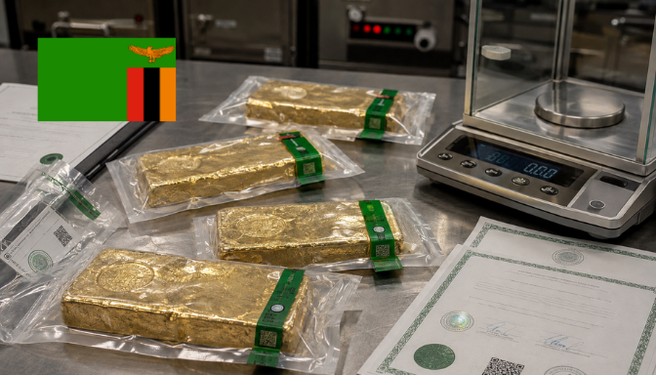
LUSAKA — Zambia’s gold market is moving from fragmented, informal dealing towards a more controlled system built around licensed production, documented trading, mineral analysis and traceable exports. That shift is creating legitimate opportunities for refiners, bullion buyers, commodity traders and investors—but it is also closing the space in which undocumented gold, borrowed licences and airport handover schemes once passed as normal business.
The rule for any serious buyer is simple: buying and exporting gold from Zambia is not a cash-and-carry transaction. A lawful deal must connect the gold to an authorised source, the seller to a valid right or permit, the shipment to an official assay and valuation, the tax position to mineral royalty clearance, and the physical export to both regulatory and customs approval.
If one link is missing, the buyer may not have an exportable commodity at all.
Zambia’s New Gold Trading Order
Zambia’s governing mining law is the Minerals Regulation Commission Act No. 14 of 2024. The law came into force on 13 June 2025 and transferred core licensing, monitoring and enforcement functions to the Minerals Regulation Commission, or MRC.
The Commission is empowered to grant, suspend and revoke mining and non-mining rights; regulate mineral marketing; provide laboratory analysis and valuation; monitor mineral exports; and work with other authorities to combat illegal mining, mineral smuggling and tax evasion.
That institutional change matters. Gold transactions that might once have relied on a Ministry letter, an intermediary’s assurances or a photocopied licence must now be tested against the MRC-administered framework and the current status of the underlying rights.
The Government has also been formalising artisanal and small-scale production, training mining co-operatives and developing regulated gold marketing infrastructure. Zambia Gold Company, which is owned by ZCCM Investments Holdings and the Ministry of Finance, participates in mining, processing, refining and the purchase of gold from artisanal and small-scale miners. Its role is evidence of a more structured market, but it does not remove the need for each private buyer to establish its own authority, source documentation and export approvals.
Can a Foreign Buyer Purchase Gold in Zambia?
Yes, foreign participation is possible, but the correct legal vehicle and permit position must be established before trading begins.
Under the current Act, a company applying for a mining or non-mining right must be incorporated under Zambia’s Companies Act, maintain a registered office in Zambia and hold a valid tax clearance certificate from the Zambia Revenue Authority. The Act does not reserve a mineral trading permit to citizens in the same express way that it reserves a gold-panning certificate to a citizen or a citizens-only co-operative.
Foreign buyers should nevertheless obtain written confirmation of the current application requirements from the MRC. Some legacy government service pages still display eligibility language and procedures drawn from the previous regulatory system. No investor should build a transaction structure around an old webpage, an unverified consultant or a permit issued to an unrelated company.
In practice, an international buyer normally needs a properly incorporated Zambian trading vehicle, tax registration, a local bank account and compliance systems capable of meeting mineral-trading, customs and anti-money-laundering obligations. Alternatively, the buyer may purchase through a demonstrably licensed Zambian exporter, while retaining contractual inspection, assay and payment controls.
The Licences That Control the Transaction
Three authorisations must not be confused.
First, the source of the gold must be lawful. The producer should hold the relevant mining licence, mineral processing licence or gold-panning certificate. A gold-panning certificate is available only to Zambian citizens or co-operatives consisting entirely of citizens and applies to a defined area.
Second, a person who buys and sells minerals generally requires a mineral trading permit. A holder of a mining licence or mineral processing licence may trade without a separate trading permit, but every other trader must hold one. Under the 2024 Act, the MRC is required to issue a compliant mineral trading permit application within seven days, and the permit is valid for three years and renewable.
Third, the authority to trade does not equal the authority to export. Every person exporting a mineral, ore, gemstone or mineral product must obtain a mineral export permit from the MRC. A trading permit, mining licence or processing licence cannot be substituted for the shipment-specific export approval.
Trading without the required permit is a criminal offence. The Act provides for a fine of up to 500,000 penalty units, imprisonment for up to five years, or both. The commercial loss can be greater: seizure, delayed cargo, cancelled banking relationships, tax exposure and an unusable chain of title can destroy the entire transaction.
How to Buy and Export Gold From Zambia Legally
1. Establish the Buyer and Payment Structure
Before negotiating kilograms and discounts, determine who will be the legal buyer, exporter of record and recipient of the export proceeds. Complete company incorporation where required, obtain a Taxpayer Identification Number, secure tax clearance and open an account with a bank that understands precious-metals transactions.
The contracting entity, invoice issuer, permit holder, customs exporter and bank-account beneficiary should align. Unexplained substitutions between companies are a major compliance warning.
2. Verify the Seller Before Verifying the Gold
Obtain the seller’s certificate of incorporation, beneficial-ownership details, tax clearance, identity documents for directors and authorised signatories, registered address, bank confirmation and board or corporate authority to transact.
Then verify the applicable mining licence, mineral processing licence, gold-panning certificate or mineral trading permit directly with the MRC. Check the legal name, number, status, expiry date, authorised mineral, licence area and any suspension or compliance notice. A genuine licence belonging to someone else does not legalise the seller’s transaction.
3. Prove the Gold’s Source
The export file must identify the mining right or mineral processing licence from which the gold originates. For a trader, the purchase record should lead back through each supplier to that lawful source.
Request production returns or trade returns, purchase invoices, delivery notes, transport records, weighbridge or scale records, batch identifiers and evidence of mineral royalty compliance. Where artisanal production is aggregated, test the membership, operating area and authorisation of each co-operative or supplier represented in the batch.
Do not accept “family gold”, “village gold”, “old stock”, “customs gold” or “government allocation” as a substitute for legal provenance.
4. Sign a Conditional Contract, Not an Irrevocable Promise to Pay
The sale and purchase agreement should make the transaction conditional on successful licence verification, source verification, independent assay, royalty clearance, security clearance, export approval and destination-country import acceptance.
It should identify the form of the product—dust, concentrate, doré or refined bullion—the provisional weight and purity, the pricing benchmark, payable percentage, refining charges, taxes, insurance, delivery point, title transfer and risk transfer.
For doré, the commercial value is based on contained fine gold, not gross bar weight. A 10-kilogram doré lot assaying at 85% gold contains 8.5 kilograms of fine gold before agreed payability, refining costs and other contractual adjustments.
5. Control Weighing, Sampling and Assay
Inspect the gold at an agreed secure location. Record the gross weight, seal numbers and batch numbers in the presence of both parties. Sampling must be representative and tamper-evident.
X-ray fluorescence can provide a rapid indication of surface composition, but it should not be the sole settlement method for heterogeneous doré or concentrates. The contract should specify an accepted laboratory method, usually including fire assay where appropriate, split samples for buyer and seller, and a sealed umpire sample for disputes.
No buyer should release the full price against a photograph, handheld tester result or seller-controlled assay alone.
6. Obtain Official Analysis and Valuation
The MRC must analyse and value minerals intended for export and issue the mineral analysis and valuation certificate required for the export-permit process. The official valuation is also relevant to the assessment of mineral royalty and other payments due to Zambia.
The commercial parties may commission independent assays for settlement, but private laboratory work does not replace the certificate required by the regulator.
7. Clear Mineral Royalty and Tax
Gold is a precious metal under the Act. The statutory mineral royalty rate for precious metals is 6% of the applicable norm value. The mining licence holder is ordinarily responsible for the royalty, but the Act also makes a person in possession of minerals extracted in Zambia liable where the royalty has not been paid.
That provision makes royalty verification a buyer issue, not merely a seller issue. The exporter must obtain a mineral royalty clearance certificate from the Zambia Revenue Authority before the MRC can issue the mineral export permit.
ZRA classifies qualifying exports of gold, platinum, silver, palladium and selenium as zero-rated supplies for value-added tax purposes. Separately, Zambia suspended the 15% export duty on precious stones and metals through Statutory Instrument No. 4 of 2025. Because customs and tax measures can change, exporters should confirm the applicable treatment and tariff code with ZRA for each shipment before fixing the final price.
8. Secure Police Clearance and the Mineral Export Permit
The export applicant must obtain security clearance from the Zambia Police Service. The MRC export application must then be supported by the official mineral analysis and valuation certificate, ZRA mineral royalty clearance, police security clearance, production or trade returns, and evidence of the mining right or processing licence that is the source of the gold.
The MRC may prescribe additional requirements. Current forms, fees and submission channels should therefore be confirmed directly at the time of application.
The cargo should not leave controlled custody—and final payment should not become unconditional—until the permit has been independently authenticated and matched to the actual weight, description, exporter and destination of the shipment.
9. Complete ZRA Customs Formalities
An exporter must register with ZRA for a TPIN and make the required customs declaration. The customs file will ordinarily include the commercial invoice, packing details, transport document, mineral export permit, analysis and valuation documents, royalty clearance and any evidence required for origin, insurance or destination-country entry.
Use an authorised customs clearing agent where required or commercially prudent. Classify the product accurately: gold powder, unwrought doré, semi-manufactured gold and monetary gold are not interchangeable customs descriptions. Misclassification can change duties, reporting obligations and the legality of the destination import.
The shipment should move through an approved port or airport under insured, professional precious-cargo logistics. Hand-carrying gold through passenger channels is not a shortcut around mineral and customs law.
10. Confirm the Destination Before Dispatch
A Zambian export permit does not guarantee admission into another country. Before shipment, confirm the buyer’s bullion or precious-metals licence, import permission, customs classification, tax treatment, sanctions screening, responsible-sourcing requirements and refinery acceptance criteria in the destination market.
The receiving refinery or vault should approve the shipper, estimated purity, packaging, airway bill instructions and chain-of-custody protocol in advance. The buyer should also confirm whether the refinery will accept artisanal or aggregated material and what OECD-aligned responsible-sourcing evidence it requires.
Documents a Bankable Gold Export File Should Contain
A serious transaction file should include, at minimum:
Buyer and seller incorporation records, beneficial ownership and tax clearance.
Identity and authority documents for every signatory and representative.
Valid mining, processing or gold-panning authority for the source.
Valid precious-metals trading permit where the seller or exporter requires one.
MRC verification of licence and permit status.
Production returns or trade returns linked to the shipment.
Source invoices, delivery notes, transport records and batch ledger.
Executed sale and purchase agreement and commercial invoice.
Independent assay reports and sampling record.
MRC mineral analysis and valuation certificate.
ZRA mineral royalty clearance certificate.
Zambia Police Service security clearance.
MRC mineral export permit.
Customs declaration and authorised transport documentation.
Cargo insurance, seal log, chain-of-custody record and destination import approval.
AML, sanctions, politically exposed person and adverse-media screening results.
Copies should be independently verified with the issuing authority. A document pack supplied entirely by the broker is not independent due diligence.
Anti-Money-Laundering Controls Are Not Optional
Zambia’s Financial Intelligence Centre treats dealers in precious stones and metals as reporting entities exposed to elevated money-laundering and terrorist-financing risk. Dealers are expected to apply a risk-based compliance programme covering customer due diligence, beneficial ownership, transaction monitoring, record retention and suspicious-transaction reporting, among other controls.
Gold is compact, internationally liquid and easy to misdescribe. Those characteristics make anonymous cash settlement, third-party payments, unexplained crypto transfers, split invoices and offshore payment instructions especially dangerous.
The safest payment path is transparent and banked. Funds should move between accounts held in the contracting parties’ names, against verified documentary milestones. Escrow can reduce performance risk, but it does not cure illegal source, defective title or missing export authority.
The Contract Terms That Protect the Buyer
A bankable Zambian gold contract should address:
Exact product form, estimated quantity, minimum and maximum purity.
Agreed benchmark price and pricing time, usually tied to a recognised international gold benchmark.
Payable gold percentage, treatment and refining charges, penalties and deductions.
Sampling protocol, assay method, laboratory selection and umpire procedure.
Source warranties and continuous validity of all licences and permits.
No child labour, illegal mining, conflict financing, corruption or sanctions breach.
Seller responsibility for royalty and taxes, with documentary clearance as a payment condition.
Delivery term, secure location, exporter of record and customs responsibility.
The precise point at which title and risk pass.
Insurance and chain-of-custody requirements.
Conditions precedent, termination rights, indemnities and recovery of advance payments.
Governing law, dispute forum and emergency relief for fraud or threatened movement of cargo.
A discount is not security. If the buyer cannot prove the source, assay the product, control the documents and enforce the agreement, even a spectacular price is commercially meaningless.
Gold Scam Warnings Buyers Should Never Ignore
The most dangerous warning signs are remarkably consistent:
Gold is offered at a deep discount to international value without an economically credible explanation.
The seller demands “licence”, “release”, “anti-terror”, “airport storage” or “diplomatic seal” fees before independent verification.
The named seller, licence holder, invoice issuer and bank beneficiary are different entities.
The seller refuses an MRC verification, mine visit, controlled sampling or independent assay.
A broker produces a genuine licence that does not belong to the contracting seller or does not cover the source area.
The buyer is shown one sample but is denied control over the final batch and seals.
Payment is requested in cash, cryptocurrency, to a personal account or to a third country with no contractual role.
The exporter promises to obtain permits after receiving the purchase price.
The shipment is proposed as passenger luggage, courier cargo or a diplomatic consignment designed to avoid normal customs controls.
Officials communicate only through personal email addresses or messaging accounts and refuse verification through published government contacts.
When two or more of these signs appear, the correct commercial response is usually to stop, not to negotiate a better discount.
What a Realistic Transaction Timeline Looks Like
The Act sets a seven-day period for issuing a compliant mineral trading permit, but that does not mean a new buyer can complete an entire gold export in seven days. Company, tax, banking, due-diligence, assay, royalty, police, export-permit, customs, logistics and destination requirements operate as separate workstreams.
Timelines also depend on the completeness of the source records and whether authorities require clarification or inspection. Buyers should budget for verification and regulatory sequencing rather than accept a broker’s promise of same-day export.
Zambia’s Opportunity Is in Controlled, Traceable Gold
Zambia’s emerging gold sector offers real commercial promise. The country is formalising artisanal production, building marketing infrastructure and increasing regulatory visibility beyond its traditional copper industry. For credible buyers, the opportunity is not simply access to gold; it is the ability to build transparent offtake relationships with lawful producers and aggregators before the market matures.
The winners will be the parties that treat compliance as part of the asset. Verified origin improves financeability. Reliable assay improves pricing. Documented royalties protect title. Controlled logistics preserve the chain of custody. Proper contracts turn an introduction into an executable trade.
AFRINOMICS Deal Room is designed to channel qualified commercial interest into controlled mandates, acquisition opportunities and live deal-room teasers. Buyers, sellers and mandate holders can use the platform to begin structured engagement—but every transaction remains subject to independent legal, technical, financial, tax and regulatory due diligence.
The central lesson is uncompromising: in Zambia’s gold market, the gold is only as valuable as the legal chain that carries it from the ground to the buyer.
Regulatory Note
This report is general market information, not legal, tax, customs or investment advice. Requirements, fees, tax measures and procedures can change. Parties should obtain written confirmation from the Minerals Regulation Commission, Zambia Revenue Authority, Zambia Police Service, Financial Intelligence Centre and destination-country authorities before committing funds or moving gold.
Official and Primary References
Minerals Regulation Commission Act No. 14 of 2024 — National Assembly of Zambia
Ministry of Mines and Minerals Development — Trading Permit
Ministry of Mines and Minerals Development — Mineral Export Permit
Zambia Revenue Authority — Exportation of Goods
Zambia Revenue Authority — Tax Information
Financial Intelligence Centre — Dealers in Precious Stones and Metals Guidelines
ZCCM Investments Holdings — Zambia Gold Company