Gold mining can generate export earnings, employment and demand for African engineering, transport and equipment services. Its long-term contribution, however, depends on how operations manage the environmental and social costs of extraction. A commercially productive mine can still leave communities facing contaminated water, damaged land and expensive rehabilitation obligations.
Sustainable gold mining in Africa should therefore be understood as an operational discipline rather than a marketing label. The objective is to reduce harm, manage unavoidable impacts and ensure that financial returns do not depend on transferring environmental liabilities to communities or governments. For investors, this means evaluating the quality of a project’s environmental planning alongside its geology, recovery rates and operating costs.
There is no single continent-wide “2025 standard” governing every gold operation. National requirements, permit conditions and financing obligations differ. Nevertheless, established international guidance provides a practical foundation for improving extraction, protecting communities and planning for mine closure.
Environmental assessment must shape the investment decision
Environmental and Social Impact Assessments should influence project design before major development commitments are made. Baseline studies need to establish how a proposed mine could affect water supplies, biodiversity, livelihoods and community health. They should also compare alternatives, including different plant locations, waste-storage arrangements and infrastructure routes.
The applicable approval process must be checked in each jurisdiction. Tanzania’s published mining assessment guidance, for example, distinguishes between projects requiring a mandatory assessment and smaller projects subject to screening. This illustrates why operators should not assume that identical procedures apply to every mine or activity.
For financiers, the central question is whether identified risks have credible management measures, budgets and accountable personnel. An assessment document alone does not establish that a project is ready for investment. Environmental and social commitments need to become operating requirements that can be monitored throughout the project’s life.
Rehabilitation should begin during operations
Land restoration should be incorporated into mine planning rather than deferred entirely until production ends. Progressive rehabilitation allows operators to stabilise completed areas, control erosion and test restoration methods while machinery and technical teams remain available. Protecting suitable topsoil and limiting unnecessary disturbance can improve subsequent recovery.
In agricultural landscapes, including parts of Mali and Côte d’Ivoire, rehabilitation planning should consider surrounding livelihoods. However, returning mined land to farming is not always technically safe or ecologically appropriate. Post-mining land use must reflect soil conditions, contamination risks, water availability and community priorities. Native vegetation may support recovery, but restoration should match the original ecosystem rather than assume that every site requires tree planting.
The commercial implication is straightforward: closure is a project cost, not an optional future expense. Investment appraisals should account for rehabilitation, monitoring and any continuing treatment obligations.
Cleaner recovery starts with understanding the ore
Mercury-free gold recovery is an important priority for artisanal and small-scale mining. Established gravity methods, including appropriately designed sluices, shaking tables and centrifugal concentrators, can recover gold without mercury. Their suitability depends on mineralogy, particle size, liberation and access to water and power.
Flotation requires a different distinction. It can concentrate gold-bearing minerals, but it is not automatically a complete gold-extraction process or a chemical-free technology. Concentrates may still require further treatment. Equipment selection should therefore follow representative metallurgical testing, not broad claims that one machine or flowsheet is suitable for every deposit.
Where cyanide is used, responsible management must cover transport, storage, containment, worker training, emergency response and decommissioning. The International Cyanide Management Code provides a voluntary framework for these activities; it does not replace national law or certify the sustainability of an entire mining operation.
For smaller African operators, technology programmes should combine equipment access with training, maintenance and credible recovery testing. Financing machinery without building the capacity to operate it safely can leave both production and environmental objectives unmet.
Water efficiency must be measured across the whole site
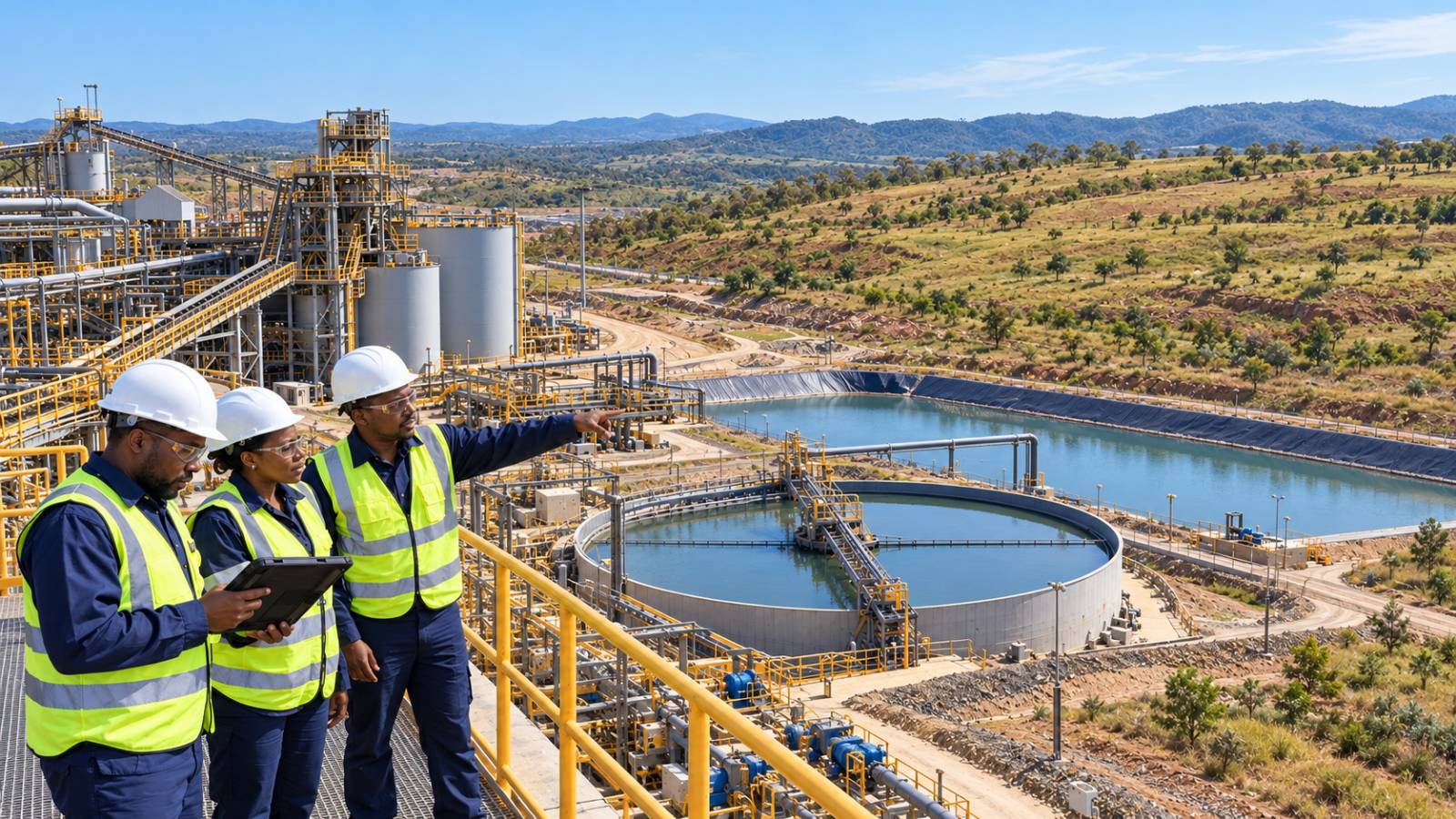
Water management requires a site-wide balance covering abstraction, rainfall, process circulation, evaporation, seepage and discharge. Recycling process water and separating clean runoff from contaminated streams can reduce pressure on freshwater resources. Recirculation does not, however, eliminate water losses or automatically remove the need for treatment.
Operators should also assess whether waste rock or tailings could generate acidic or metal-contaminated drainage. These risks can continue after mining ends, making prevention and long-term management essential components of plant design and closure planning.
For operations in water-stressed settings, the investment test should extend beyond the advertised recycling rate. Decision-makers should ask whether the system remains functional during drought, intense rainfall, equipment failure and changes in ore characteristics.
Tailings safety requires engineering and accountability
Tailings management is a lifecycle responsibility. The Global Industry Standard on Tailings Management addresses site selection, design, operation, monitoring, closure and post-closure, alongside independent oversight and public disclosure. Its emphasis is on preventing harm through both technical controls and organisational accountability.
Filtered or dry-stack tailings should be evaluated where appropriate, but should not be presented as a universal requirement or a guarantee of safety. The selected approach needs competent engineering assessment suited to the site and material. Procurement decisions must consider the entire storage system, not simply the purchase of dewatering equipment.
Communities potentially affected by a facility also need understandable information and practical emergency arrangements. Safety commitments become meaningful when responsibilities, monitoring results and corrective actions are visible.
Energy investment should improve resilience as well as emissions
Energy efficiency should accompany new generation capacity. Operators should investigate inefficient equipment, avoidable pumping demand and maintenance-related losses before sizing additional power systems.
Renewable generation can reduce diesel consumption, but solar and wind output varies. Mine power systems therefore require an appropriate combination of generation, storage, controls and dependable backup. Hybrid systems can support lower emissions and reduced fuel exposure, although their economics depend on the site, operating profile and remaining mine life.
For investment appraisal, headline electricity prices are insufficient. The comparison should include installation, financing, maintenance, replacement components and the cost of interruptions. A system that appears inexpensive but cannot support critical process loads may create significant operational risk.
Community participation must extend beyond employment promises
Responsible mining requires ongoing engagement with affected people, not consultation confined to the approval stage. Environmental and social performance frameworks emphasise stakeholder engagement, disclosure and management of risks throughout the investment lifecycle.
Local recruitment, apprenticeships and supplier development should be designed around realistic opportunities. Training in equipment maintenance, electrical work, water monitoring and rehabilitation can build capabilities that remain useful beyond the mine.
Community programmes should not substitute for addressing adverse impacts. Operators need accessible grievance channels and a clear process for responding to concerns. Public reporting should distinguish promised benefits from delivered outcomes and explain how shortcomings are being corrected.
The investment opportunity is in verifiable performance
For equipment buyers and financiers, sustainable gold mining creates demand for more than extraction machinery. It also requires dependable water-treatment plants, recovery circuits, monitoring instruments, efficient power systems and rehabilitation services.
Procurement should connect each investment to a measurable operating objective. A water project should demonstrate reduced freshwater demand or improved treatment performance. A recovery upgrade should show results from representative ore testing. An energy installation should demonstrate dependable supply under realistic operating conditions.
Africa’s gold mining future will not be secured by environmental claims alone. It will depend on mines that can demonstrate responsible production, fund their long-term obligations and deliver lasting value to surrounding economies. The strongest projects will treat these requirements as part of how gold is produced—not as additions considered after the investment decision.
Explore Plant & Equipment opportunities on AFRINOMICS for gold-processing machinery, water-management systems and energy infrastructure. Assess each solution against site-specific technical requirements and independently verified performance.
Back to AFRINOMICS News
The Future of Mining in Africa: Best Practices for Sustainable Gold Extraction
Africa’s gold mining future depends on safer extraction, responsible water use and stronger community partnerships—with sustainability built into project economics.
Published22 Oct 2026, 13:05/AuthorJohn Phiri
More from AFRINOMICS News
29 Sept 2026, 21:18
Platform IntelligenceCobalt: The African Mineral the World Still Depends On
29 Sept 2026, 18:09
Deal RoomMineral Deal Financing: How to Broker Mining Transactions
29 Sept 2026, 17:28
OperationsHow Mineral Beneficiation Can Create Jobs Beyond Mining in Africa

29 Sept 2026, 15:33
Minerals ExchangeAfrican Minerals That Are Driving the AI Economy

29 Sept 2026, 15:08
Minerals ExchangeCritical Battery Minerals in Africa: Key Resources and Mining Hubs

29 Sept 2026, 14:23
Minerals ExchangeSemiconductor Companies and Their Reliance on African Minerals

29 Sept 2026, 13:48
Minerals ExchangeAfrican Minerals in Your iPhone: The Mining Behind the Technology
22 Sept 2026, 21:12
Minerals ExchangeTop Chrome Producers in Africa Key Players Shaping the Mining Sector
22 Sept 2026, 19:57
Plant & EquipmentAffordable Manganese Beneficiation: Plant Setup Solutions for SME Mining in Africa
10 Sept 2026, 19:49
ExplorationFund the Mine: How to Raise Capital for an African Mining Project